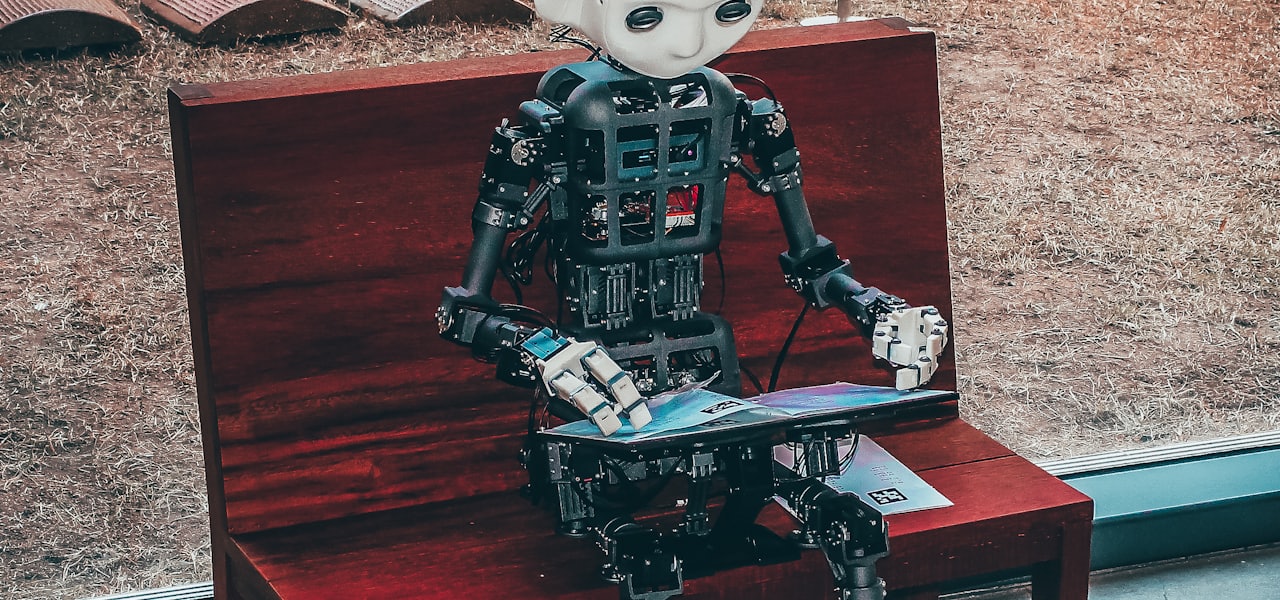
Developmental robotics (DevRob), sometimes called epigenetic robotics, is a scientific field which aims at studying the developmental mechanisms, architectures and constraints that allow lifelong and open-ended learning of new skills and new knowledge in embodied machines. As in human children, learning is expected to be cumulative and of progressively increasing complexity, and to result from self-exploration of the world in combination with social interaction. The typical methodological approach consists in starting from theories of human and animal development elaborated in fields such as developmental psychology, neuroscience, developmental and evolutionary biology, and linguistics, then to formalize and implement them in robots, sometimes exploring extensions or variants of them. The experimentation of those models in robots allows researchers to confront them with reality, and as a consequence, developmental robotics also provides feedback and novel hypotheses on theories of human and animal development. Developmental robotics is related to but differs from evolutionary robotics (ER). ER uses populations of robots that evolve over time, whereas DevRob is interested in how the organization of a single robot's control system develops through experience, over time. DevRob is also related to work done in the domains of robotics and artificial life. == Background == Can a robot learn like a child? Can it learn a variety of new skills and new knowledge unspecified at design time and in a partially unknown and changing environment? How can it discover its body and its relationships with the physical and social environment? How can its cognitive capacities continuously develop without the intervention of an engineer once it is "out of the factory"? What can it learn through natural social interactions with humans? These are the questions at the center of developmental robotics. Alan Turing, as well as a number of other pioneers of cybernetics, already formulated those questions and the general approach in 1950, but it is only since the end of the 20th century that they began to be investigated systematically. Because the concept of adaptive intelligent machines is central to developmental robotics, it has relationships with fields such as artificial intelligence, machine learning, cognitive robotics or computational neuroscience. Yet, while it may reuse some of the techniques elaborated in these fields, it differs from them from many perspectives. It differs from classical artificial intelligence because it does not assume the capability of advanced symbolic reasoning and focuses on embodied and situated sensorimotor and social skills rather than on abstract symbolic problems. It differs from cognitive robotics because it focuses on the processes that allow the formation of cognitive capabilities rather than these capabilities themselves. It differs from computational neuroscience because it focuses on functional modeling of integrated architectures of development and learning. More generally, developmental robotics is uniquely characterized by the following three features: It targets task-independent architectures and learning mechanisms, i.e. the machine/robot has to be able to learn new tasks that are unknown by the engineer; It emphasizes open-ended development and lifelong learning, i.e. the capacity of an organism to acquire continuously novel skills. This should not be understood as a capacity for learning "anything" or even “everything”, but just that the set of skills that is acquired can be infinitely extended at least in some (not all) directions; The complexity of acquired knowledge and skills shall increase (and the increase be controlled) progressively. Developmental robotics emerged at the crossroads of several research communities including embodied artificial intelligence, enactive and dynamical systems cognitive science, connectionism. Starting from the essential idea that learning and development happen as the self-organized result of the dynamical interactions among brains, bodies and their physical and social environment, and trying to understand how this self-organization can be harnessed to provide task-independent lifelong learning of skills of increasing complexity, developmental robotics strongly interacts with fields such as developmental psychology, developmental and cognitive neuroscience, developmental biology (embryology), evolutionary biology, and cognitive linguistics. As many of the theories coming from these sciences are verbal and/or descriptive, this implies a crucial formalization and computational modeling activity in developmental robotics. These computational models are then not only used as ways to explore how to build more versatile and adaptive machines but also as a way to evaluate their coherence and possibly explore alternative explanations for understanding biological development. == Research directions == === Skill domains === Due to the general approach and methodology, developmental robotics projects typically focus on having robots develop the same types of skills as human infants. A first category that is important being investigated is the acquisition of sensorimotor skills. These include the discovery of one's own body, including its structure and dynamics such as hand-eye coordination, locomotion, and interaction with objects as well as tool use, with a particular focus on the discovery and learning of affordances. A second category of skills targeted by developmental robots are social and linguistic skills: the acquisition of simple social behavioural games such as turn-taking, coordinated interaction, lexicons, syntax and grammar, and the grounding of these linguistic skills into sensorimotor skills (sometimes referred as symbol grounding). In parallel, the acquisition of associated cognitive skills are being investigated such as the emergence of the self/non-self distinction, the development of attentional capabilities, of categorization systems and higher-level representations of affordances or social constructs, of the emergence of values, empathy, or theories of mind. === Mechanisms and constraints === The sensorimotor and social spaces in which humans and robot live are so large and complex that only a small part of potentially learnable skills can actually be explored and learnt within a life-time. Thus, mechanisms and constraints are necessary to guide developmental organisms in their development and control of the growth of complexity. There are several important families of these guiding mechanisms and constraints which are studied in developmental robotics, all inspired by human development: Motivational systems, generating internal reward signals that drive exploration and learning, which can be of two main types: extrinsic motivations push robots/organisms to maintain basic specific internal properties such as food and water level, physical integrity, or light (e.g. in phototropic systems); intrinsic motivations push robot to search for novelty, challenge, compression or learning progress per se, thus generating what is sometimes called curiosity-driven learning and exploration, or alternatively active learning and exploration; Social guidance: as humans learn a lot by interacting with their peers, developmental robotics investigates mechanisms that can allow robots to participate to human-like social interaction. By perceiving and interpreting social cues, this may allow robots both to learn from humans (through diverse means such as imitation, emulation, stimulus enhancement, demonstration, etc. ...) and to trigger natural human pedagogy. Thus, social acceptance of developmental robots is also investigated; Statistical inference biases and cumulative knowledge/skill reuse: biases characterizing both representations/encodings and inference mechanisms can typically allow considerable improvement of the efficiency of learning and are thus studied. Related to this, mechanisms allowing to infer new knowledge and acquire new skills by reusing previously learnt structures is also an essential field of study; The properties of embodiment, including geometry, materials, or innate motor primitives/synergies often encoded as dynamical systems, can considerably simplify the acquisition of sensorimotor or social skills, and is sometimes referred as morphological computation. The interaction of these constraints with other constraints is an important axis of investigation; Maturational constraints: In human infants, both the body and the neural system grow progressively, rather than being full-fledged already at birth. This implies, for example, that new degrees of freedom, as well as increases of the volume and resolution of available sensorimotor signals, may appear as learning and development unfold. Transposing these mechanisms in developmental robots, and understanding how it may hinder or on the contrary ease the acquisition of novel complex skills is a central questi
Cross-validation (statistics)
Cross-validation, sometimes called rotation estimation or out-of-sample testing, is any of various similar model validation techniques for assessing how the results of a statistical analysis will generalize to an independent data set. Cross-validation includes resampling and sample splitting methods that use different portions of the data to test and train a model on different iterations. It is often used in settings where the goal is prediction, and one wants to estimate how accurately a predictive model will perform in practice. It can also be used to assess the quality of a fitted model and the stability of its parameters. In a prediction problem, a model is usually given a dataset of known data on which training is run (training dataset), and a dataset of unknown data (or first seen data) against which the model is tested (called the validation dataset or testing set). The goal of cross-validation is to test the model's ability to predict new data that was not used in estimating it, in order to flag problems like overfitting or selection bias and to give an insight on how the model will generalize to an independent dataset (i.e., an unknown dataset, for instance from a real problem). One round of cross-validation involves partitioning a sample of data into complementary subsets, performing the analysis on one subset (called the training set), and validating the analysis on the other subset (called the validation set or testing set). To reduce variability, in most methods multiple rounds of cross-validation are performed using different partitions, and the validation results are combined (e.g. averaged) over the rounds to give an estimate of the model's predictive performance. In summary, cross-validation combines (averages) measures of fitness in prediction to derive a more accurate estimate of model prediction performance. == Motivation == Assume a model with one or more unknown parameters, and a data set to which the model can be fit (the training data set). The fitting process optimizes the model parameters to make the model fit the training data as well as possible. If an independent sample of validation data is taken from the same population as the training data, it will generally turn out that the model does not fit the validation data as well as it fits the training data. The size of this difference is likely to be large especially when the size of the training data set is small, or when the number of parameters in the model is large. Cross-validation is a way to estimate the size of this effect. === Example: linear regression === In linear regression, there exist real response values y 1 , … , y n {\textstyle y_{1},\ldots ,y_{n}} , and n p-dimensional vector covariates x1, ..., xn. The components of the vector xi are denoted xi1, ..., xip. If least squares is used to fit a function in the form of a hyperplane ŷ = a + βTx to the data (xi, yi) 1 ≤ i ≤ n, then the fit can be assessed using the mean squared error (MSE). The MSE for given estimated parameter values a and β on the training set (xi, yi) 1 ≤ i ≤ n is defined as: MSE = 1 n ∑ i = 1 n ( y i − y ^ i ) 2 = 1 n ∑ i = 1 n ( y i − a − β T x i ) 2 = 1 n ∑ i = 1 n ( y i − a − β 1 x i 1 − ⋯ − β p x i p ) 2 {\displaystyle {\begin{aligned}{\text{MSE}}&={\frac {1}{n}}\sum _{i=1}^{n}(y_{i}-{\hat {y}}_{i})^{2}={\frac {1}{n}}\sum _{i=1}^{n}(y_{i}-a-{\boldsymbol {\beta }}^{T}\mathbf {x} _{i})^{2}\\&={\frac {1}{n}}\sum _{i=1}^{n}(y_{i}-a-\beta _{1}x_{i1}-\dots -\beta _{p}x_{ip})^{2}\end{aligned}}} If the model is correctly specified, it can be shown under mild assumptions that the expected value of the MSE for the training set is (n − p − 1)/(n + p + 1) < 1 times the expected value of the MSE for the validation set (the expected value is taken over the distribution of training sets). Thus, a fitted model and computed MSE on the training set will result in an optimistically biased assessment of how well the model will fit an independent data set. This biased estimate is called the in-sample estimate of the fit, whereas the cross-validation estimate is an out-of-sample estimate. Since in linear regression it is possible to directly compute the factor (n − p − 1)/(n + p + 1) by which the training MSE underestimates the validation MSE under the assumption that the model specification is valid, cross-validation can be used for checking whether the model has been overfitted, in which case the MSE in the validation set will substantially exceed its anticipated value. (Cross-validation in the context of linear regression is also useful in that it can be used to select an optimally regularized cost function.) === General case === In most other regression procedures (e.g. logistic regression), there is no simple formula to compute the expected out-of-sample fit. Cross-validation is, thus, a generally applicable way to predict the performance of a model on unavailable data using numerical computation in place of theoretical analysis. == Types == Two types of cross-validation can be distinguished: exhaustive and non-exhaustive cross-validation. === Exhaustive cross-validation === Exhaustive cross-validation methods are cross-validation methods which learn and test on all possible ways to divide the original sample into a training and a validation set. ==== Leave-p-out cross-validation ==== Leave-p-out cross-validation (LpO CV) involves using p observations as the validation set and the remaining observations as the training set. This is repeated on all ways to cut the original sample on a validation set of p observations and a training set. LpO cross-validation require training and validating the model C p n {\displaystyle C_{p}^{n}} times, where n is the number of observations in the original sample, and where C p n {\displaystyle C_{p}^{n}} is the binomial coefficient. For p > 1 and for even moderately large n, LpO CV can become computationally infeasible. For example, with n = 100 and p = 30, C 30 100 ≈ 3 × 10 25 . {\displaystyle C_{30}^{100}\approx 3\times 10^{25}.} A variant of LpO cross-validation with p=2 known as leave-pair-out cross-validation has been recommended as a nearly unbiased method for estimating the area under ROC curve of binary classifiers. ==== Leave-one-out cross-validation ==== Leave-one-out cross-validation (LOOCV) is a particular case of leave-p-out cross-validation with p = 1. The process looks similar to jackknife; however, with cross-validation one computes a statistic on the left-out sample(s), while with jackknifing one computes a statistic from the kept samples only. LOO cross-validation requires less computation time than LpO cross-validation because there are only C 1 n = n {\displaystyle C_{1}^{n}=n} passes rather than C p n {\displaystyle C_{p}^{n}} . However, n {\displaystyle n} passes may still require quite a large computation time, in which case other approaches such as k-fold cross validation may be more appropriate. Pseudo-code algorithm: Input: x, {vector of length N with x-values of incoming points} y, {vector of length N with y-values of the expected result} interpolate( x_in, y_in, x_out ), { returns the estimation for point x_out after the model is trained with x_in-y_in pairs} Output: err, {estimate for the prediction error} Steps: err ← 0 for i ← 1, ..., N do // define the cross-validation subsets x_in ← (x[1], ..., x[i − 1], x[i + 1], ..., x[N]) y_in ← (y[1], ..., y[i − 1], y[i + 1], ..., y[N]) x_out ← x[i] y_out ← interpolate(x_in, y_in, x_out) err ← err + (y[i] − y_out)^2 end for err ← err/N === Non-exhaustive cross-validation === Non-exhaustive cross validation methods do not compute all ways of splitting the original sample. These methods are approximations of leave-p-out cross-validation. ==== k-fold cross-validation ==== In k-fold cross-validation, the original sample is randomly partitioned into k equal sized subsamples, often referred to as "folds". Of the k subsamples, a single subsample is retained as the validation data for testing the model, and the remaining k − 1 subsamples are used as training data. The cross-validation process is then repeated k times, with each of the k subsamples used exactly once as the validation data. The k results can then be averaged to produce a single estimation. The advantage of this method over repeated random sub-sampling (see below) is that all observations are used for both training and validation, and each observation is used for validation exactly once. 10-fold cross-validation is commonly used, but in general k remains an unfixed parameter. For example, setting k = 2 results in 2-fold cross-validation. In 2-fold cross-validation, the dataset is randomly shuffled into two sets d0 and d1, so that both sets are equal size (this is usually implemented by shuffling the data array and then splitting it in two). We then train on d0 and validate on d1, followed by training on d1 and validating on d0. When k = n (the number of observations), k-fold cross-validation is equivalent to leave-one-out cr
Independent component analysis
In signal processing, independent component analysis (ICA) is a computational method for separating a multivariate signal into additive subcomponents. This is done by assuming that at most one subcomponent is Gaussian and that the subcomponents are statistically independent from each other. ICA was invented by Jeanny Hérault and Christian Jutten in 1985. ICA is a special case of blind source separation. A common example application of ICA is the "cocktail party problem" of listening in on one person's speech in a noisy room. == Introduction == Independent component analysis attempts to decompose a multivariate signal into independent non-Gaussian signals. As an example, sound is usually a signal that is composed of the numerical addition, at each time t, of signals from several sources. The question then is whether it is possible to separate these contributing sources from the observed total signal. When the statistical independence assumption is correct, blind ICA separation of a mixed signal gives very good results. It is also used for signals that are not supposed to be generated by mixing for analysis purposes. A simple application of ICA is the "cocktail party problem", where the underlying speech signals are separated from a sample data consisting of people talking simultaneously in a room. Usually the problem is simplified by assuming no time delays or echoes. Note that a filtered and delayed signal is a copy of a dependent component, and thus the statistical independence assumption is not violated. Mixing weights for constructing the M {\textstyle M} observed signals from the N {\textstyle N} components can be placed in an M × N {\textstyle M\times N} matrix. An important thing to consider is that if N {\textstyle N} sources are present, at least N {\textstyle N} observations (e.g. microphones if the observed signal is audio) are needed to recover the original signals. When there are an equal number of observations and source signals, the mixing matrix is square ( M = N {\textstyle M=N} ). Other cases of underdetermined ( M < N {\textstyle M
Sammon mapping
Sammon mapping or Sammon projection is an algorithm that maps a high-dimensional space to a space of lower dimensionality (see multidimensional scaling) by trying to preserve the structure of inter-point distances in high-dimensional space in the lower-dimension projection. It is particularly suited for use in exploratory data analysis. The method was proposed by John W. Sammon in 1969. It is considered a non-linear approach as the mapping cannot be represented as a linear combination of the original variables as possible in techniques such as principal component analysis, which also makes it more difficult to use for classification applications. Denote the distance between ith and jth objects in the original space by d i j ∗ {\displaystyle \scriptstyle d_{ij}^{}} , and the distance between their projections by d i j {\displaystyle \scriptstyle d_{ij}^{}} . Sammon's mapping aims to minimize the following error function, which is often referred to as Sammon's stress or Sammon's error: E = 1 ∑ i < j d i j ∗ ∑ i < j ( d i j ∗ − d i j ) 2 d i j ∗ . {\displaystyle E={\frac {1}{\sum \limits _{i Probabilistic latent semantic analysis (PLSA), also known as probabilistic latent semantic indexing (PLSI, especially in information retrieval circles) is a statistical technique for the analysis of two-mode and co-occurrence data. In effect, one can derive a low-dimensional representation of the observed variables in terms of their affinity to certain hidden variables, just as in latent semantic analysis, from which PLSA evolved. Compared to standard latent semantic analysis which stems from linear algebra and downsizes the occurrence tables (usually via a singular value decomposition), probabilistic latent semantic analysis is based on a mixture decomposition derived from a latent class model. == Model == Considering observations in the form of co-occurrences ( w , d ) {\displaystyle (w,d)} of words and documents, PLSA models the probability of each co-occurrence as a mixture of conditionally independent multinomial distributions: P ( w , d ) = ∑ c P ( d ) P ( c | d ) P ( w | c ) = P ( d ) ∑ c P ( c | d ) P ( w | c ) {\displaystyle P(w,d)=\sum _{c}P(d)P(c|d)P(w|c)=P(d)\sum _{c}P(c|d)P(w|c)} with c {\displaystyle c} being the words' topic. Note that the number of topics is a hyperparameter that must be chosen in advance and is not estimated from the data. The first formulation is the symmetric formulation, where w {\displaystyle w} and d {\displaystyle d} are both generated from the latent class c {\displaystyle c} in similar ways (using the conditional probabilities P ( d | c ) {\displaystyle P(d|c)} and P ( w | c ) {\displaystyle P(w|c)} ), whereas the second formulation is the asymmetric formulation, where, for each document d {\displaystyle d} , a latent class is chosen conditionally to the document according to P ( c | d ) {\displaystyle P(c|d)} , and a word is then generated from that class according to P ( w | c ) {\displaystyle P(w|c)} . Although we have used words and documents in this example, the co-occurrence of any couple of discrete variables may be modelled in exactly the same way. So, the number of parameters is equal to c d + w c {\displaystyle cd+wc} . The number of parameters grows linearly with the number of documents. In addition, although PLSA is a generative model of the documents in the collection it is estimated on, it is not a generative model of new documents. Their parameters are learned using the EM algorithm. == Application == PLSA may be used in a discriminative setting, via Fisher kernels. PLSA has applications in information retrieval and filtering, natural language processing, machine learning from text, bioinformatics, and related areas. It is reported that the aspect model used in the probabilistic latent semantic analysis has severe overfitting problems. == Extensions == Hierarchical extensions: Asymmetric: MASHA ("Multinomial ASymmetric Hierarchical Analysis") Symmetric: HPLSA ("Hierarchical Probabilistic Latent Semantic Analysis") Generative models: The following models have been developed to address an often-criticized shortcoming of PLSA, namely that it is not a proper generative model for new documents. Latent Dirichlet allocation – adds a Dirichlet prior on the per-document topic distribution Higher-order data: Although this is rarely discussed in the scientific literature, PLSA extends naturally to higher order data (three modes and higher), i.e. it can model co-occurrences over three or more variables. In the symmetric formulation above, this is done simply by adding conditional probability distributions for these additional variables. This is the probabilistic analogue to non-negative tensor factorisation. == History == This is an example of a latent class model (see references therein), and it is related to non-negative matrix factorization. The present terminology was coined in 1999 by Thomas Hofmann. Arabic Ontology is a website offering linguistic ontology services for the Arabic language which can be used like the online site WordNet. Users can use Arabic Ontology to classify or clarify the concepts and meanings of Arabic terms. == Ontology Structure == The ontology structure (i.e., data model) is similar to WordNet's structure. Each concept in the database is given a unique concept identifier (URI), informally described by a gloss, and lexicalized by one or more synonymous lemma terms. Each term-concept pair is called a sense, and is given a SenseID. A set of senses is called synset. Concepts and senses are described by further attributes such as era and area — to specify example usage and ontological analysis. Semantic relations are defined between concepts. Some important entities are included in the ontology, such as individual countries and bodies of water. These individuals are given separate IndividualIDs and linked with their concepts through the InstanceOf relation. == Mappings to other resources == Concepts in the Arabic Ontology are mapped to synsets in WordNet, as well as to BFO and DOLCE. Terms used in the Arabic Ontology are mapped to lemmas in the LDC's SAMA database. == Applications == Arabic Ontology can be used in many application domains, such as: Information retrieval, to enrich queries (e.g., in search engines) and improve the quality of the results, i.e. meaningful search rather than string-matching search; Machine translation and word-sense disambiguation, by finding the exact mapping of concepts across languages, especially that the Arabic ontology is also mapped to the WordNet; Data Integration and interoperability in which the Arabic ontology can be used as a semantic reference to link databases and information systems; Semantic Web and Web 3.0, by using the Arabic ontology as a semantic reference to disambiguate the meanings used in websites; among many other applications. == URLs Design == The URLs in the Arabic Ontology are designed according to the W3C's Best Practices for Publishing Linked Data, as described in the following URL schemes. This allows one to also explore the whole database like exploring a graph: Ontology Concept: Each concept in the Arabic Ontology has a ConceptID and can be accessed using: https://{domain}/concept/{ConceptID | Term}. In case of a term, the set of concepts that this term lexicalizes are all retrieved. In case of a ConceptID, the concept and its direct subtypes are retrieved, e.g. https://ontology.birzeit.edu/concept/293198 Semantic relations: Relationships between concepts can be accessed using these schemes: (i) the URL: https:// {domain}/concept/{RelationName}/{ConceptID} allows retrieval of relationships among ontology concepts. (ii) the URL: https://{domain}/lexicalconcept/{RelationName}/{lexicalConceptID} allows retrieval of relations between lexical concepts. For example, https://ontology.birzeit.edu/concept/instances/293121 retrieves the instances of the concept 293121. The relations that are currently used in our database are: {subtypes, type, instances, parts, related, similar, equivalent}. In computer programming, genetic representation is a way of presenting solutions/individuals in evolutionary computation methods. The term encompasses both the concrete data structures and data types used to realize the genetic material of the candidate solutions in the form of a genome, and the relationships between search space and problem space. In the simplest case, the search space corresponds to the problem space (direct representation). The choice of problem representation is tied to the choice of genetic operators, both of which have a decisive effect on the efficiency of the optimization. Genetic representation can encode appearance, behavior, physical qualities of individuals. Difference in genetic representations is one of the major criteria drawing a line between known classes of evolutionary computation. Terminology is often analogous with natural genetics. The block of computer memory that represents one candidate solution is called an individual. The data in that block is called a chromosome. Each chromosome consists of genes. The possible values of a particular gene are called alleles. A programmer may represent all the individuals of a population using binary encoding, permutational encoding, encoding by tree, or any one of several other representations. == Representations in some popular evolutionary algorithms == Genetic algorithms (GAs) are typically linear representations; these are often, but not always, binary. Holland's original description of GA used arrays of bits. Arrays of other types and structures can be used in essentially the same way. The main property that makes these genetic representations convenient is that their parts are easily aligned due to their fixed size. This facilitates simple crossover operation. Depending on the application, variable-length representations have also been successfully used and tested in evolutionary algorithms (EA) in general and genetic algorithms in particular, although the implementation of crossover is more complex in this case. Evolution strategy uses linear real-valued representations, e.g., an array of real values. It uses mostly gaussian mutation and blending/averaging crossover. Genetic programming (GP) pioneered tree-like representations and developed genetic operators suitable for such representations. Tree-like representations are used in GP to represent and evolve functional programs with desired properties. Human-based genetic algorithm (HBGA) offers a way to avoid solving hard representation problems by outsourcing all genetic operators to outside agents, in this case, humans. The algorithm has no need for knowledge of a particular fixed genetic representation as long as there are enough external agents capable of handling those representations, allowing for free-form and evolving genetic representations. === Common genetic representations === binary array integer or real-valued array binary tree natural language parse tree directed graph == Distinction between search space and problem space == Analogous to biology, EAs distinguish between problem space (corresponds to phenotype) and search space (corresponds to genotype). The problem space contains concrete solutions to the problem being addressed, while the search space contains the encoded solutions. The mapping from search space to problem space is called genotype-phenotype mapping. The genetic operators are applied to elements of the search space, and for evaluation, elements of the search space are mapped to elements of the problem space via genotype-phenotype mapping. == Relationships between search space and problem space == The importance of an appropriate choice of search space for the success of an EA application was recognized early on. The following requirements can be placed on a suitable search space and thus on a suitable genotype-phenotype mapping: === Completeness === All possible admissible solutions must be contained in the search space. === Redundancy === When more possible genotypes exist than phenotypes, the genetic representation of the EA is called redundant. In nature, this is termed a degenerate genetic code. In the case of a redundant representation, neutral mutations are possible. These are mutations that change the genotype but do not affect the phenotype. Thus, depending on the use of the genetic operators, there may be phenotypically unchanged offspring, which can lead to unnecessary fitness determinations, among other things. Since the evaluation in real-world applications usually accounts for the lion's share of the computation time, it can slow down the optimization process. In addition, this can cause the population to have higher genotypic diversity than phenotypic diversity, which can also hinder evolutionary progress. In biology, the Neutral Theory of Molecular Evolution states that this effect plays a dominant role in natural evolution. This has motivated researchers in the EA community to examine whether neutral mutations can improve EA functioning by giving populations that have converged to a local optimum a way to escape that local optimum through genetic drift. This is discussed controversially and there are no conclusive results on neutrality in EAs. On the other hand, there are other proven measures to handle premature convergence. === Locality === The locality of a genetic representation corresponds to the degree to which distances in the search space are preserved in the problem space after genotype-phenotype mapping. That is, a representation has a high locality exactly when neighbors in the search space are also neighbors in the problem space. In order for successful schemata not to be destroyed by genotype-phenotype mapping after a minor mutation, the locality of a representation must be high. === Scaling === In genotype-phenotype mapping, the elements of the genotype can be scaled (weighted) differently. The simplest case is uniform scaling: all elements of the genotype are equally weighted in the phenotype. A common scaling is exponential. If integers are binary coded, the individual digits of the resulting binary number have exponentially different weights in representing the phenotype. Example: The number 90 is written in binary (i.e., in base two) as 1011010. If now one of the front digits is changed in the binary notation, this has a significantly greater effect on the coded number than any changes at the rear digits (the selection pressure has an exponentially greater effect on the front digits). For this reason, exponential scaling has the effect of randomly fixing the "posterior" locations in the genotype before the population gets close enough to the optimum to adjust for these subtleties. == Hybridization and repair in genotype-phenotype mapping == When mapping the genotype to the phenotype being evaluated, domain-specific knowledge can be used to improve the phenotype and/or ensure that constraints are met. This is a commonly used method to improve EA performance in terms of runtime and solution quality. It is illustrated below by two of the three examples. == Examples == === Example of a direct representation === An obvious and commonly used encoding for the traveling salesman problem and related tasks is to number the cities to be visited consecutively and store them as integers in the chromosome. The genetic operators must be suitably adapted so that they only change the order of the cities (genes) and do not cause deletions or duplications. Thus, the gene order corresponds to the city order and there is a simple one-to-one mapping. === Example of a complex genotype-phenotype mapping === In a scheduling task with heterogeneous and partially alternative resources to be assigned to a set of subtasks, the genome must contain all necessary information for the individual scheduling operations or it must be possible to derive them from it. In addition to the order of the subtasks to be executed, this includes information about the resource selection. A phenotype then consists of a list of subtasks with their start times and assigned resources. In order to be able to create this, as many allocation matrices must be created as resources can be allocated to one subtask at most. In the simplest case this is one resource, e.g., one machine, which can perform the subtask. An allocation matrix is a two-dimensional matrix, with one dimension being the available time units and the other being the resources to be allocated. Empty matrix cells indicate availability, while an entry indicates the number of the assigned subtask. The creation of allocation matrices ensures firstly that there are no inadmissible multiple allocations. Secondly, the start times of the subtasks can be read from it as well as the assigned resources. A common constraint when scheduling resources to subtasks is that a resource can only be allocated once per time unit and that the reservation must be for a contiguous period of time. To achieve this in a timely manner, which is a cProbabilistic latent semantic analysis
Arabic Ontology
Genetic representation