InteLex Past Masters is a collection of full-text web-based scholarly editions of classic works in the humanities. InteLex Corporation was founded in 1989 by its current chief executive officer, Mark Rooks, to produce electronic versions of the works of the great philosophers, based on existing scholarly editions. The company is located in Charlottesville, Virginia. Its databases are marketed to academic institutions, with pricing based on the individual collections purchased. Content is provided in XML and searchable image format and is accessed through the InteLex Corporation website. In addition to philosophy, subject coverage includes religious studies, English literature, women's writing, social science, and history of science. InteLex databases are found in institutions in over 65 countries around the world.
Developmental robotics
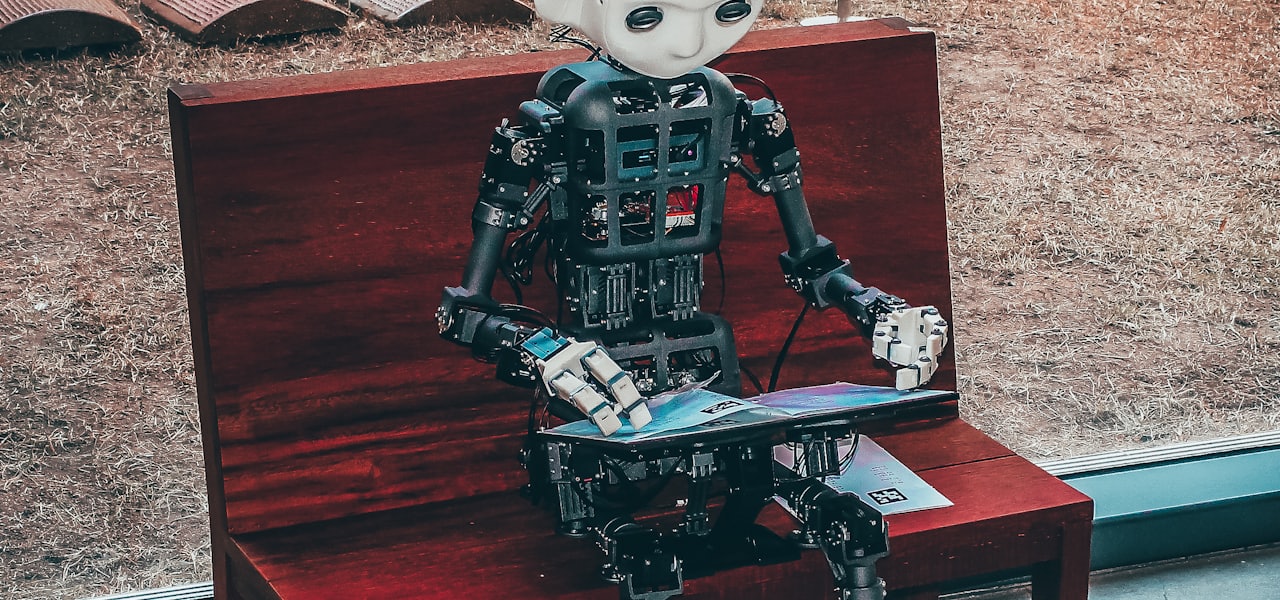
Developmental robotics (DevRob), sometimes called epigenetic robotics, is a scientific field which aims at studying the developmental mechanisms, architectures and constraints that allow lifelong and open-ended learning of new skills and new knowledge in embodied machines. As in human children, learning is expected to be cumulative and of progressively increasing complexity, and to result from self-exploration of the world in combination with social interaction. The typical methodological approach consists in starting from theories of human and animal development elaborated in fields such as developmental psychology, neuroscience, developmental and evolutionary biology, and linguistics, then to formalize and implement them in robots, sometimes exploring extensions or variants of them. The experimentation of those models in robots allows researchers to confront them with reality, and as a consequence, developmental robotics also provides feedback and novel hypotheses on theories of human and animal development. Developmental robotics is related to but differs from evolutionary robotics (ER). ER uses populations of robots that evolve over time, whereas DevRob is interested in how the organization of a single robot's control system develops through experience, over time. DevRob is also related to work done in the domains of robotics and artificial life. == Background == Can a robot learn like a child? Can it learn a variety of new skills and new knowledge unspecified at design time and in a partially unknown and changing environment? How can it discover its body and its relationships with the physical and social environment? How can its cognitive capacities continuously develop without the intervention of an engineer once it is "out of the factory"? What can it learn through natural social interactions with humans? These are the questions at the center of developmental robotics. Alan Turing, as well as a number of other pioneers of cybernetics, already formulated those questions and the general approach in 1950, but it is only since the end of the 20th century that they began to be investigated systematically. Because the concept of adaptive intelligent machines is central to developmental robotics, it has relationships with fields such as artificial intelligence, machine learning, cognitive robotics or computational neuroscience. Yet, while it may reuse some of the techniques elaborated in these fields, it differs from them from many perspectives. It differs from classical artificial intelligence because it does not assume the capability of advanced symbolic reasoning and focuses on embodied and situated sensorimotor and social skills rather than on abstract symbolic problems. It differs from cognitive robotics because it focuses on the processes that allow the formation of cognitive capabilities rather than these capabilities themselves. It differs from computational neuroscience because it focuses on functional modeling of integrated architectures of development and learning. More generally, developmental robotics is uniquely characterized by the following three features: It targets task-independent architectures and learning mechanisms, i.e. the machine/robot has to be able to learn new tasks that are unknown by the engineer; It emphasizes open-ended development and lifelong learning, i.e. the capacity of an organism to acquire continuously novel skills. This should not be understood as a capacity for learning "anything" or even “everything”, but just that the set of skills that is acquired can be infinitely extended at least in some (not all) directions; The complexity of acquired knowledge and skills shall increase (and the increase be controlled) progressively. Developmental robotics emerged at the crossroads of several research communities including embodied artificial intelligence, enactive and dynamical systems cognitive science, connectionism. Starting from the essential idea that learning and development happen as the self-organized result of the dynamical interactions among brains, bodies and their physical and social environment, and trying to understand how this self-organization can be harnessed to provide task-independent lifelong learning of skills of increasing complexity, developmental robotics strongly interacts with fields such as developmental psychology, developmental and cognitive neuroscience, developmental biology (embryology), evolutionary biology, and cognitive linguistics. As many of the theories coming from these sciences are verbal and/or descriptive, this implies a crucial formalization and computational modeling activity in developmental robotics. These computational models are then not only used as ways to explore how to build more versatile and adaptive machines but also as a way to evaluate their coherence and possibly explore alternative explanations for understanding biological development. == Research directions == === Skill domains === Due to the general approach and methodology, developmental robotics projects typically focus on having robots develop the same types of skills as human infants. A first category that is important being investigated is the acquisition of sensorimotor skills. These include the discovery of one's own body, including its structure and dynamics such as hand-eye coordination, locomotion, and interaction with objects as well as tool use, with a particular focus on the discovery and learning of affordances. A second category of skills targeted by developmental robots are social and linguistic skills: the acquisition of simple social behavioural games such as turn-taking, coordinated interaction, lexicons, syntax and grammar, and the grounding of these linguistic skills into sensorimotor skills (sometimes referred as symbol grounding). In parallel, the acquisition of associated cognitive skills are being investigated such as the emergence of the self/non-self distinction, the development of attentional capabilities, of categorization systems and higher-level representations of affordances or social constructs, of the emergence of values, empathy, or theories of mind. === Mechanisms and constraints === The sensorimotor and social spaces in which humans and robot live are so large and complex that only a small part of potentially learnable skills can actually be explored and learnt within a life-time. Thus, mechanisms and constraints are necessary to guide developmental organisms in their development and control of the growth of complexity. There are several important families of these guiding mechanisms and constraints which are studied in developmental robotics, all inspired by human development: Motivational systems, generating internal reward signals that drive exploration and learning, which can be of two main types: extrinsic motivations push robots/organisms to maintain basic specific internal properties such as food and water level, physical integrity, or light (e.g. in phototropic systems); intrinsic motivations push robot to search for novelty, challenge, compression or learning progress per se, thus generating what is sometimes called curiosity-driven learning and exploration, or alternatively active learning and exploration; Social guidance: as humans learn a lot by interacting with their peers, developmental robotics investigates mechanisms that can allow robots to participate to human-like social interaction. By perceiving and interpreting social cues, this may allow robots both to learn from humans (through diverse means such as imitation, emulation, stimulus enhancement, demonstration, etc. ...) and to trigger natural human pedagogy. Thus, social acceptance of developmental robots is also investigated; Statistical inference biases and cumulative knowledge/skill reuse: biases characterizing both representations/encodings and inference mechanisms can typically allow considerable improvement of the efficiency of learning and are thus studied. Related to this, mechanisms allowing to infer new knowledge and acquire new skills by reusing previously learnt structures is also an essential field of study; The properties of embodiment, including geometry, materials, or innate motor primitives/synergies often encoded as dynamical systems, can considerably simplify the acquisition of sensorimotor or social skills, and is sometimes referred as morphological computation. The interaction of these constraints with other constraints is an important axis of investigation; Maturational constraints: In human infants, both the body and the neural system grow progressively, rather than being full-fledged already at birth. This implies, for example, that new degrees of freedom, as well as increases of the volume and resolution of available sensorimotor signals, may appear as learning and development unfold. Transposing these mechanisms in developmental robots, and understanding how it may hinder or on the contrary ease the acquisition of novel complex skills is a central questi
User-defined function
A user-defined function (UDF) is a function provided by the user of a program or environment, in a context where the usual assumption is that functions are built into the program or environment. UDFs are usually written for the requirement of its creator. == BASIC language == In some old implementations of the BASIC programming language, user-defined functions are defined using the "DEF FN" syntax. More modern dialects of BASIC are influenced by the structured programming paradigm, where most or all of the code is written as user-defined functions or procedures, and the concept becomes practically redundant. == COBOL language == In the COBOL programming language, a user-defined function is an entity that is defined by the user by specifying a FUNCTION-ID paragraph. A user-defined function must return a value by specifying the RETURNING phrase of the procedure division header and they are invoked using the function-identifier syntax. See the ISO/IEC 1989:2014 Programming Language COBOL standard for details. As of May 2022, the IBM Enterprise COBOL for z/OS 6.4 (IBM COBOL) compiler contains support for user-defined functions. == Databases == In relational database management systems, a user-defined function provides a mechanism for extending the functionality of the database server by adding a function, that can be evaluated in standard query language (usually SQL) statements. The SQL standard distinguishes between scalar and table functions. A scalar function returns only a single value (or NULL), whereas a table function returns a (relational) table comprising zero or more rows, each row with one or more columns. User-defined functions in SQL are declared using the CREATE FUNCTION statement. For example, a user-defined function that converts Celsius to Fahrenheit (a temperature scale used in USA) might be declared like this: Once created, a user-defined function may be used in expressions in SQL statements. For example, it can be invoked where most other intrinsic functions are allowed. This also includes SELECT statements, where the function can be used against data stored in tables in the database. Conceptually, the function is evaluated once per row in such usage. For example, assume a table named Elements, with a row for each known chemical element. The table has a column named BoilingPoint for the boiling point of that element, in Celsius. The query would retrieve the name and the boiling point from each row. It invokes the CtoF user-defined function as declared above in order to convert the value in the column to a value in Fahrenheit. Each user-defined function carries certain properties or characteristics. The SQL standard defines the following properties: Language - defines the programming language in which the user-defined function is implemented; examples include SQL, C, C# and Java. Parameter style - defines the conventions that are used to pass the function parameters and results between the implementation of the function and the database system (only applicable if language is not SQL). Specific name - a name for the function that is unique within the database. Note that the function name does not have to be unique, considering overloaded functions. Some SQL implementations require that function names are unique within a database, and overloaded functions are not allowed. Determinism - specifies whether the function is deterministic or not. The determinism characteristic has an influence on the query optimizer when compiling a SQL statement. SQL-data access - tells the database management system whether the function contains no SQL statements (NO SQL), contains SQL statements but does not access any tables or views (CONTAINS SQL), reads data from tables or views (READS SQL DATA), or actually modifies data in the database (MODIFIES SQL DATA). User-defined functions should not be confused with stored procedures. Stored procedures allow the user to group a set of SQL commands. A procedure can accept parameters and execute its SQL statements depending on those parameters. A procedure is not an expression and, thus, cannot be used like user-defined functions. Some database management systems allow the creation of user defined functions in languages other than SQL. Microsoft SQL Server, for example, allows the user to use .NET languages including C# for this purpose. DB2 and Oracle support user-defined functions written in C or Java programming languages. === SQL Server 2000 === There are three types of UDF in Microsoft SQL Server 2000: scalar functions, inline table-valued functions, and multistatement table-valued functions. Scalar functions return a single data value (not a table) with RETURNS clause. Scalar functions can use all scalar data types, with exception of timestamp and user-defined data types. Inline table-valued functions return the result set of a single SELECT statement. Multistatement table-valued functions return a table, which was built with many TRANSACT-SQL statements. User-defined functions can be invoked from a query like built‑in functions such as OBJECT_ID, LEN, DATEDIFF, or can be executed through an EXECUTE statement like stored procedures. Performance Notes: User-defined functions are subroutines made of one or more Transact-SQL statements that can be used to encapsulate code for reuse. It takes zero or more arguments and evaluates a return value. Has both control-flow and DML statements in its body similar to stored procedures. Does not allow changes to any Global Session State, like modifications to database or external resource, such as a file or network. Does not support output parameter. DEFAULT keyword must be specified to pass the default value of parameter. Errors in UDF cause UDF to abort which, in turn, aborts the statement that invoked the UDF. === Apache Hive === Apache Hive defines, in addition to the regular user-defined functions (UDF), also user-defined aggregate functions (UDAF) and table-generating functions (UDTF). Hive enables developers to create their own custom functions with Java. === Apache Doris === Apache Doris, an open-source real-time analytical database, allows external users to contribute their own UDFs written in C++ to it.
Data remanence
Data remanence is the residual representation of digital data that remains even after attempts have been made to remove or erase the data. This residue may result from data being left intact by a nominal file deletion operation, by reformatting of storage media that does not remove data previously written to the media, or through physical properties of the storage media that allow previously written data to be recovered. Data remanence may make inadvertent disclosure of sensitive information possible should the storage media be released into an uncontrolled environment (e.g., thrown in refuse containers or lost). Various techniques have been developed to counter data remanence. These techniques are classified as clearing, purging/sanitizing, or destruction. Specific methods include overwriting, degaussing, encryption, and media destruction. Effective application of countermeasures can be complicated by several factors, including media that are inaccessible, media that cannot effectively be erased, advanced storage systems that maintain histories of data throughout the data's life cycle, and persistence of data in memory that is typically considered volatile. Several standards exist for the secure removal of data and the elimination of data remanence. == Causes == Many operating systems, file managers, and other software provide a facility where a file is not immediately deleted when the user requests that action. Instead, the file is moved to a holding area (i.e. the "trash"), making it easy for the user to undo a mistake. Similarly, many software products automatically create backup copies of files that are being edited, to allow the user to restore the original version, or to recover from a possible crash (autosave feature). Even when an explicit deleted file retention facility is not provided or when the user does not use it, operating systems do not actually remove the contents of a file when it is deleted unless they are aware that explicit erasure commands are required, like on a solid-state drive. (In such cases, the operating system will issue the Serial ATA TRIM command or the SCSI UNMAP command to let the drive know to no longer maintain the deleted data.) Instead, they simply remove the file's entry from the file system directory because this requires less work and is therefore faster, and the contents of the file—the actual data—remain on the storage medium. The data will remain there until the operating system reuses the space for new data. In some systems, enough filesystem metadata are also left behind to enable easy undeletion by commonly available utility software. Even when undelete has become impossible, the data, until it has been overwritten, can be read by software that reads disk sectors directly. Computer forensics often employs such software. Likewise, reformatting, repartitioning, or reimaging a system is unlikely to write to every area of the disk, though all will cause the disk to appear empty or, in the case of reimaging, empty except for the files present in the image, to most software. Finally, even when the storage media is overwritten, physical properties of the media may permit recovery of the previous contents. In most cases however, this recovery is not possible by just reading from the storage device in the usual way, but requires using laboratory techniques such as disassembling the device and directly accessing/reading from its components. § Complications below gives further explanations for causes of data remanence. == Countermeasures == There are three levels commonly recognized for eliminating remnant data: === Clearing === Clearing is the removal of sensitive data from storage devices in such a way that there is assurance that the data may not be reconstructed using normal system functions or software file/data recovery utilities. The data may still be recoverable, but not without special laboratory techniques. Clearing is typically an administrative protection against accidental disclosure within an organization. For example, before a hard drive is re-used within an organization, its contents may be cleared to prevent their accidental disclosure to the next user. === Purging === Purging or sanitizing is the physical rewrite of sensitive data from a system or storage device done with the specific intent of rendering the data unrecoverable at a later time. Purging, proportional to the sensitivity of the data, is generally done before releasing media beyond control, such as before discarding old media, or moving media to a computer with different security requirements. === Destruction === The storage media is made unusable for conventional equipment. Effectiveness of destroying the media varies by medium and method. Depending on recording density of the media, and/or the destruction technique, this may leave data recoverable by laboratory methods. Conversely, destruction using appropriate techniques is the most secure method of preventing retrieval. == Specific methods == === Overwriting === A common method used to counter data remanence is to overwrite the storage media with new data. This is often called wiping or shredding a disk or file, by analogy to common methods of destroying print media, although the mechanism bears no similarity to these. Because such a method can often be implemented in software alone, and may be able to selectively target only part of the media, it is a popular, low-cost option for some applications. Overwriting is generally an acceptable method of clearing, as long as the media is writable and not damaged. The simplest overwrite technique writes the same data everywhere—often just a pattern of all zeros. At a minimum, this will prevent the data from being retrieved simply by reading from the media again using standard system functions. The UEFI in modern machines may offer an ATA class disk erase function as well. The ATA-6 standard governs secure erases specifications. Bitlocker is whole disk encryption and illegible without the key. Writing a fresh GPT allows a new file system to be established. Blocks will set empty but LBA read is illegible. New data will be unaffected and work fine. In an attempt to counter more advanced data recovery techniques, specific overwrite patterns and multiple passes have often been prescribed. These may be generic patterns intended to eradicate any trace signatures; an example is the seven-pass pattern 0xF6, 0x00, 0xFF,
Attack path management
Attack path management is a cybersecurity technique that involves the continuous discovery, mapping, and risk assessment of identity-based attack paths. Attack path management is distinct from other computer security mitigation strategies in that it does not rely on finding individual attack paths through vulnerabilities, exploits, or offensive testing. Rather, attack path management techniques analyze all attack paths present in an environment based on active identity management policies, authentication configurations, and active authenticated "sessions" between objects. == Overview == Attack path management relies on concepts such as mapping and removing attack paths, identifying attack path choke points, and remediation of attack paths. Identity-based attacks are present in most publicly disclosed breaches, whether through social engineering to gain initial access to Active Directories or lateral movement for privilege escalation. Attackers require privileges to attack an environment’s most sensitive segments. Attack path management often involves removing out-of-date privileges and privilege assignments given to overly large groups. In attack path management, attack graphs are used to represent how a network of machines’ security is vulnerable to attack. The nodes in an attack graph represent principals and other objects such as machines, accounts, and security groups. The edges in an attack graph represent the links and relationships between nodes. Some nodes are easy to penetrate due to short paths from regular users to domain admins, resulting in focal points of concentrated network traffic, which are known as attack path choke points. Attack graphs are often analyzed using algorithms and visualization. Attack path management also identifies tier 0 assets, which are considered the most vulnerable because they have direct or indirect control of an Active Directory or Microsoft Entra ID environment.
Attention (machine learning)
In machine learning, attention is a method that determines the importance of each component in a sequence relative to the other components in that sequence. In natural language processing, importance is represented by "soft" weights assigned to each word in a sentence. More generally, attention encodes vectors called token embeddings across a fixed-width sequence that can range from tens to millions of tokens in size. Unlike "hard" weights, which are computed during the backwards training pass, "soft" weights exist only in the forward pass and therefore change with every step of the input. Earlier designs implemented the attention mechanism in a serial recurrent neural network (RNN) language translation system, but a more recent design, namely the transformer, removed the slower sequential RNN and relied more heavily on the faster parallel attention scheme. Inspired by ideas about attention in humans, the attention mechanism was developed to address the weaknesses of using information from the hidden layers of recurrent neural networks. Recurrent neural networks favor information contained in words at the end of a sentence and thus deemed more recent, thereby tending to attenuate the significance and associated predictive weight assigned to information earlier in the sentence. Attention allows a token equal access to any part of a sentence directly, rather than only through the previous state. == History == Additional surveys of the attention mechanism in deep learning are provided by Niu et al. and Soydaner. The major breakthrough came with self-attention, where each element in the input sequence attends to all others, enabling the model to capture global dependencies. This idea was central to the Transformer architecture, which replaced recurrence with attention mechanisms. As a result, Transformers became the foundation for models like BERT, T5 and generative pre-trained transformers (GPT). == Overview == The modern era of machine attention was revitalized by grafting an attention mechanism (Fig 1. orange) to an Encoder-Decoder. Figure 2 shows the internal step-by-step operation of the attention block (A) in Fig 1. === Interpreting attention weights === In translating between languages, alignment is the process of matching words from the source sentence to words of the translated sentence. Networks that perform verbatim translation without regard to word order would show the highest scores along the (dominant) diagonal of the matrix. The off-diagonal dominance shows that the attention mechanism is more nuanced. Consider an example of translating I love you to French. On the first pass through the decoder, 94% of the attention weight is on the first English word I, so the network offers the word je. On the second pass of the decoder, 88% of the attention weight is on the third English word you, so it offers t'. On the last pass, 95% of the attention weight is on the second English word love, so it offers aime. In the I love you example, the second word love is aligned with the third word aime. Stacking soft row vectors together for je, t', and aime yields an alignment matrix: Sometimes, alignment can be multiple-to-multiple. For example, the English phrase look it up corresponds to cherchez-le. Thus, "soft" attention weights work better than "hard" attention weights (setting one attention weight to 1, and the others to 0), as we would like the model to make a context vector consisting of a weighted sum of the hidden vectors, rather than "the best one", as there may not be a best hidden vector. == Variants == Many variants of attention implement soft weights, such as fast weight programmers, or fast weight controllers (1992). A "slow" neural network outputs the "fast" weights of another neural network through outer products. The slow network learns by gradient descent. It was later renamed as "linearized self-attention". Bahdanau-style attention, also referred to as additive attention, Luong-style attention, which is known as multiplicative attention, Early attention mechanisms similar to modern self-attention were proposed using recurrent neural networks. However, the highly parallelizable self-attention was introduced in 2017 and successfully used in the Transformer model, positional attention and factorized positional attention. For convolutional neural networks, attention mechanisms can be distinguished by the dimension on which they operate, namely: spatial attention, channel attention, or combinations. These variants recombine the encoder-side inputs to redistribute those effects to each target output. Often, a correlation-style matrix of dot products provides the re-weighting coefficients. In the figures below, W is the matrix of context attention weights, similar to the formula in Overview section above. == Optimizations == === Flash attention === The size of the attention matrix is proportional to the square of the number of input tokens. Therefore, when the input is long, calculating the attention matrix requires a lot of GPU memory. Flash attention is an implementation that reduces the memory needs and increases efficiency without sacrificing accuracy. It achieves this by partitioning the attention computation into smaller blocks that fit into the GPU's faster on-chip memory, reducing the need to store large intermediate matrices and thus lowering memory usage while increasing computational efficiency. === FlexAttention === FlexAttention is an attention kernel developed by Meta that allows users to modify attention scores prior to softmax and dynamically chooses the optimal attention algorithm. == Applications == Attention is widely used in natural language processing, computer vision, and speech recognition. In NLP, it improves context understanding in tasks like question answering and summarization. In vision, visual attention helps models focus on relevant image regions, enhancing object detection and image captioning. === Attention maps as explanations for vision transformers === From the original paper on vision transformers (ViT), visualizing attention scores as a heat map (called saliency maps or attention maps) has become an important and routine way to inspect the decision making process of ViT models. One can compute the attention maps with respect to any attention head at any layer, while the deeper layers tend to show more semantically meaningful visualization. Attention rollout is a recursive algorithm to combine attention scores across all layers, by computing the dot product of successive attention maps. Because vision transformers are typically trained in a self-supervised manner, attention maps are generally not class-sensitive. When a classification head is attached to the ViT backbone, class-discriminative attention maps (CDAM) combines attention maps and gradients with respect to the class [CLS] token. Some class-sensitive interpretability methods originally developed for convolutional neural networks can be also applied to ViT, such as GradCAM, which back-propagates the gradients to the outputs of the final attention layer. Using attention as basis of explanation for the transformers in language and vision is not without debate. While some pioneering papers analyzed and framed attention scores as explanations, higher attention scores do not always correlate with greater impact on model performances. == Mathematical representation == === Standard scaled dot-product attention === For matrices: Q ∈ R m × d k , K ∈ R n × d k {\displaystyle Q\in \mathbb {R} ^{m\times d_{k}},K\in \mathbb {R} ^{n\times d_{k}}} and V ∈ R n × d v {\displaystyle V\in \mathbb {R} ^{n\times d_{v}}} , the scaled dot-product, or QKV attention, is defined as: Attention ( Q , K , V ) = softmax ( Q K T d k ) V ∈ R m × d v {\displaystyle {\text{Attention}}(Q,K,V)={\text{softmax}}\left({\frac {QK^{T}}{\sqrt {d_{k}}}}\right)V\in \mathbb {R} ^{m\times d_{v}}} where T {\displaystyle {}^{T}} denotes transpose and the softmax function is applied independently to every row of its argument. The matrix Q {\displaystyle Q} contains m {\displaystyle m} queries, while matrices K , V {\displaystyle K,V} jointly contain an unordered set of n {\displaystyle n} key-value pairs. Value vectors in matrix V {\displaystyle V} are weighted using the weights resulting from the softmax operation, so that the rows of the m {\displaystyle m} -by- d v {\displaystyle d_{v}} output matrix are confined to the convex hull of the points in R d v {\displaystyle \mathbb {R} ^{d_{v}}} given by the rows of V {\displaystyle V} . To understand the permutation invariance and permutation equivariance properties of QKV attention, let A ∈ R m × m {\displaystyle A\in \mathbb {R} ^{m\times m}} and B ∈ R n × n {\displaystyle B\in \mathbb {R} ^{n\times n}} be permutation matrices; and D ∈ R m × n {\displaystyle D\in \mathbb {R} ^{m\times n}} an arbitrary matrix. The softmax function is permutation equivariant in the sense that: softmax ( A D B ) = A softmax ( D ) B {\displays
Security information management
Security information management (SIM) is an information security industry term for the collection of data such as log files into a central repository for trend analysis. == Overview == SIM products generally are software agents running on the computer systems that are monitored. The recorded log information is then sent to a centralized server that acts as a "security console". The console typically displays reports, charts, and graphs of that information, often in real time. Some software agents can incorporate local filters to reduce and manipulate the data that they send to the server, although typically from a forensic point of view you would collect all audit and accounting logs to ensure you can recreate a security incident. The security console is monitored by an administrator who reviews the consolidated information and takes action in response to any alerts issued. The data that is sent to the server to be correlated and analyzed are normalized by the software agents into a common form, usually XML. Those data are then aggregated in order to reduce their overall size. == Terminology == The terminology can easily be mistaken as a reference to the whole aspect of protecting one's infrastructure from any computer security breach. Due to historic reasons of terminology evolution; SIM refers to just the part of information security which consists of discovery of 'bad behavior' or policy violations by using data collection techniques. The term commonly used to represent an entire security infrastructure that protects an environment is commonly called information security management (InfoSec). Security information management is also referred to as log management and is different from SEM (security event management), but makes up a portion of a SIEM (security information and event management) solution. == Regulatory compliance == Security information management systems support compliance with regulatory frameworks that require centralized collection and analysis of security data. The Health Insurance Portability and Accountability Act (HIPAA) Security Rule requires covered entities to implement audit controls that record and examine activity in information systems containing electronic protected health information (45 CFR 164.312(b))."45 CFR § 164.312 - Technical safeguards". Legal Information Institute. Retrieved April 1, 2026. SIM platforms aggregate these audit records to support the required regular review of information system activity records (45 CFR 164.308(a)(1)(ii)(D)). The December 2024 HIPAA Security Rule NPRM proposed requiring regulated entities to deploy automated systems capable of monitoring and recording access to ePHI, including the ability to detect unauthorized access attempts in near real-time."HIPAA Security Rule To Strengthen the Cybersecurity of Electronic Protected Health Information". Federal Register. January 6, 2025. Retrieved April 1, 2026. The Payment Card Industry Data Security Standard (PCI DSS) similarly requires centralized log management and daily review of security events (Requirements 10.4 and 10.6)."PCI DSS v4.0" (PDF). PCI Security Standards Council. March 2022. Retrieved April 1, 2026. NIST Special Publication 800-53 addresses security information management through the AU (Audit and Accountability) control family, which specifies requirements for audit event generation, content, storage, and analysis."NIST SP 800-53 Rev. 5: Security and Privacy Controls". National Institute of Standards and Technology. September 2020. Retrieved April 1, 2026.